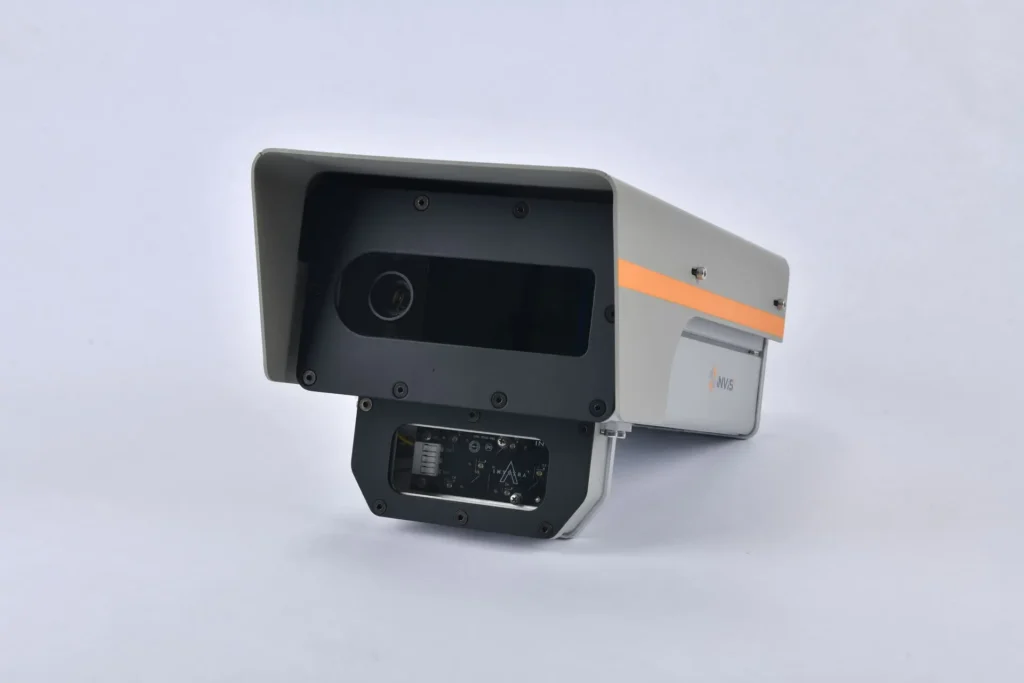
In most ETC and MLFF systems, the ANPR camera relies on external triggers — typically generated by the AVC, LiDAR, or loop sensors — to capture the right frame of a passing vehicle.
However, in real-world environments, trigger timing is rarely perfect.
Network latency, signal delay, or synchronization drift can cause the trigger to arrive a few seconds too late, resulting in a missed or blurred plate capture.
Without compensation, these small mismatches can lead to lost transactions, misreads, or the need for complex correction algorithms at the back end.
A Time-Machine ANPR camera solves this problem elegantly.
By continuously buffering image frames in internal memory, it allows the system to “look back in time” when a trigger finally arrives — even up to 20 seconds later — and select the exact frame when the vehicle was in view.
This ensures the capture happens at the correct moment, no matter when the trigger signal reaches the camera.
But timing compensation is not the only benefit.
In heavy traffic conditions, or when the AVC is uncertain about the vehicle’s class, speed, or separation distance, it may intentionally delay the trigger until the vehicle has fully passed through the detection zone.
This approach avoids sending premature or incorrect triggers and eliminates the need for additional protocol commands such as trigger deletion or correction.
In such cases, having a Time-Machine-enabled camera becomes essential — it allows the system to wait for complete and accurate vehicle data before confirming the capture, without losing the relevant image frames.
Beyond improving event accuracy, the time-machine feature provides valuable tools for system diagnostics and validation.
Operators can review the exact visual sequence before and after each event, identifying false triggers or synchronization issues in real-world operations.
It turns the camera into an intelligent data recorder, not just a plate reader.
In the INVIS ecosystem, the AEROS ANPR integrates this concept deeply at both the hardware and firmware levels.
Its intelligent image buffer, timestamp alignment, and sub-5-millisecond synchronization with AVC, RFID, and ZC units enable a unified and reliable tolling record — even in dense, high-speed traffic scenarios.
In complex, high-traffic tolling environments, a time-machine ANPR camera doesn’t just capture images — it captures the right moment.