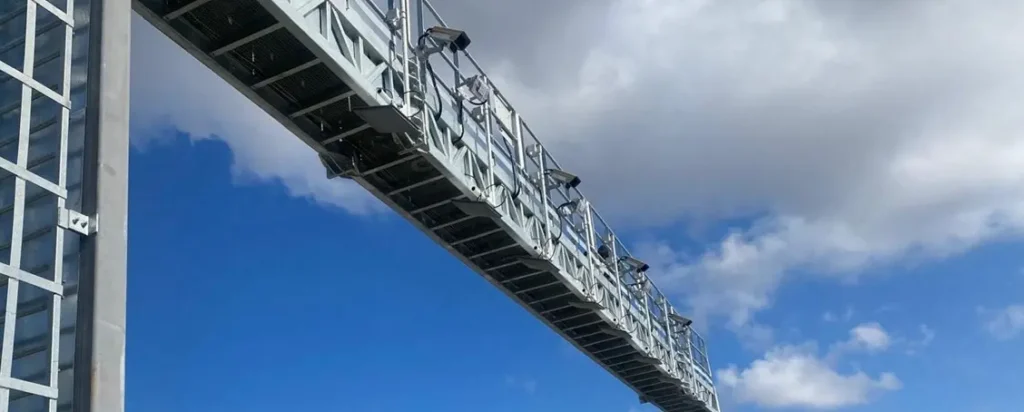
In every Multi-Lane Free-Flow (MLFF) Electronic Toll Collection (ETC) project, one of the most critical challenges is the accurate detection and localization of vehicles across multiple lanes. This responsibility falls on the Automatic Vehicle Classification (AVC) subsystem— the unit that must determine when a vehicle is present, where exactly it is located within the roadway, and how it moves through the tolling zone.
Over the years, multiple detection technologies have been used for this purpose. Yet, as MLFF systems grow more demanding in speed, accuracy, and reliability, some traditional methods are reaching their limits. Today, the industry is rapidly moving toward 2D LiDAR as the preferred detection solution— and for good reason.
This article explores the evolution of vehicle detection technologies and explains why Invis+ chose 2D LiDAR as the backbone of the AVALON AVC platform.
From Inductive Loops to Intelligent Sensing
The legacy approach: Inductive Loops
For decades, inductive loops were the standard detection method in ETC and WIM systems. Installed beneath the roadway, loops detect the presence of a vehicle by measuring variations in an oscillator’s frequency as the vehicle passes over them.
However, for modern MLFF applications, inductive loops reveal several limitations:
Limitations of Inductive Loops
- Poor lateral accuracy: Loops typically span the full lane width, making it impossible to precisely determine the vehicle’s lateral position.
- Inability to detect vehicle angle: The system cannot estimate the angle or orientation of a vehicle entering or exiting the lane.
- High installation cost: Loop installation requires cutting into the asphalt—expensive, disruptive, and time-consuming.
- Infrastructure dependency: System performance depends heavily on pavement quality.
- High failure rate: Loops consist of wound wires embedded in asphalt, making them vulnerable to wear, moisture, and road degradation.
- Difficult maintenance: Repairing or replacing loops often requires lane closures and civil work.
While inductive loops served their purpose well in earlier ETC architectures, they lack the precision and reliability needed for next-generation MLFF tolling.
The Rise of 2D LiDAR in AVC Systems
To overcome the technical and operational challenges of legacy detection, AVC systems increasingly rely on 2D LiDAR—a sensor type that scans the roadway with high-resolution laser beams, generating precise distance and shape information.
Mounted above the roadway, 2D LiDAR offers a complete transformation in how vehicles are detected, tracked, and classified.
Why 2D LiDAR? Key Advantages
1. High-precision lateral position detection
2D LiDAR captures the vehicle’s exact left-right positioning within the lane, enabling the AVC to correctly assign the vehicle to the appropriate lane—critical in MLFF environments where lane discipline is not enforced.
2. Accurate height and profile measurement
With scanning frequencies up to hundreds of Hz, LiDAR provides reliable vehicle height, silhouette, and contour information, even at highway speeds.
3. Reliable speed and length estimation
The time-based movement of LiDAR returns allows the AVC to compute:
- Vehicle speed
- Vehicle length
- Acceleration patterns
with high consistency—without ground infrastructure.
4. Easier installation, lower maintenance
LiDAR is mounted above the roadway using gantries or poles.
No cutting, no civil work, no asphalt complexity.
5. Straightforward redundancy integration
Two LiDARs can overlap their field of view, forming a redundant detection zone with dramatically increased reliability—an essential requirement for MLFF tolling.
6. Richer data output
Compared to loops (binary on/off) or magnetometers (limited vector information), LiDAR provides a detailed scan profile containing significantly more usable data.
7. Superior performance compared to other alternatives
For AVC applications, 2D LiDAR offers better practicality and accuracy than:
- 3D LiDAR (expensive, excessive data volume, unnecessary for 2D classification)
- Radar (limited profiling capability)
- Magnetic sensors (low accuracy for classification)
- Vision-only solutions (sensitive to lighting conditions)
8. Excellent cost-to-performance ratio
2D LiDAR strikes the perfect balance:
high accuracy, strong reliability, and reasonable cost, making it ideal for large-scale MLFF deployments.
Addressing the Limitations of LiDAR Technology
Like all sensors, 2D LiDAR has its challenges—particularly:
- installation alignment sensitivity
- reduced performance in heavy rain or dense spray conditions
However, both issues are fully mitigated in AVALON, our advanced AVC platform.
How AVALON Overcomes These Challenges
✔ Precise calibration tools and algorithms ensure optimal beam alignment
✔ Advanced filtering and signal-processing remove noise caused by rain
✔ Multi-frame fusion increases accuracy under adverse weather conditions
✔ Intelligent redundancy ensures no classification gaps
✔ Custom hardware and firmware designed around LiDAR’s unique characteristics
These enhancements enable AVALON to deliver consistent, high-accuracy AVC performance, even in the most challenging roadway conditions.
Why Invis+ Chose 2D LiDAR as the Core of AVALON
Because we believe the technology powering a tolling system must be:
- robust
- predictable
- high-precision
- low-maintenance
- future-proof
2D LiDAR checks all of these boxes.
Our goal was not to follow the industry— but to lead it, by designing an AVC engine that performs with the accuracy and stability required for modern MLFF tolling.
AVALON is the result of that philosophy.
Conclusion
As MLFF ETC systems evolve, accurate vehicle detection becomes one of the most critical foundations of a successful tolling operation. Traditional technologies such as inductive loops simply cannot meet the demands of today’s mobility ecosystem.
2D LiDAR provides unmatched accuracy, reliability, and practicality—making it the ideal choice for modern AVC systems.
At Invis+, we designed our AVC platform around LiDAR not because it was the easiest path, but because it was the right path.
By combining advanced sensors with intelligent algorithms and high-availability architecture, AVALON delivers the performance required for the next generation of tolling infrastructure.