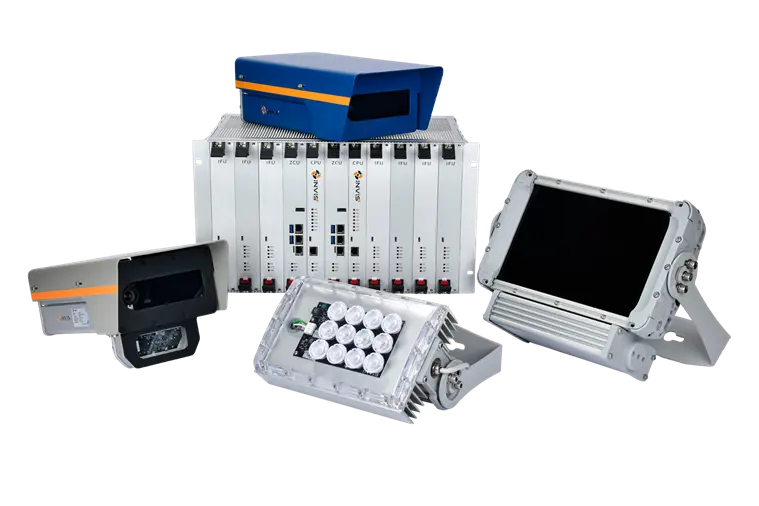
In a modern MLFF (Multi-Lane Free Flow) tolling system, time is not just a system parameter — it is a critical dimension of data integrity.
ANPR cameras, RFID readers, LiDARs, axle-counting sensors, AVC processing units, and the Zone Controller (ZC) all generate events independently. Each of these events is timestamped locally and later combined to form a single, consistent vehicle transaction.
For this process to work reliably, all field devices must remain synchronized within a very tight time window — typically no more than 2–3 milliseconds.
This requirement goes far beyond what conventional time synchronization mechanisms like NTP can guarantee.
The Limitations of Classical NTP-Based Synchronization
In many ITS and tolling deployments, all field devices are connected to a common time server such as NTP or similar services. The general behavior of these protocols is well known:
- Devices periodically correct their local clocks
- Time adjustments may happen in discrete steps
- Clock corrections can introduce sudden time jumps of tens or even hundreds of milliseconds
Under normal IT workloads, this behavior is acceptable.
In MLFF systems, it is not.
Several problematic scenarios commonly occur:
- If a camera temporarily loses connection to the NTP server, its local clock starts to drift
- Over time, this drift can reach hundreds of milliseconds or even seconds
- When connectivity is restored, the clock may jump abruptly to realign
Even when all devices are connected to NTP and the server is healthy, time corrections are not continuous and small jumps still occur.
For a tightly coupled MLFF system, this is dangerous.
Why Milliseconds Matter in MLFF
In a complete MLFF solution — combining ANPR, RFID Reader, AVC (LiDAR + axle sensors), and ZC — even a few milliseconds of time misalignment can cause serious issues:
- A LiDAR detection may be associated with the wrong image frame
- An axle sequence may be merged with another vehicle’s profile
- A tag read may be linked to the wrong vehicle
- Events from different subsystems may be ordered incorrectly
Each device generates its own timestamps for events such as:
- Vehicle entering the detection zone
- First LiDAR hit
- Axle detection
- Image capture
- Tag read
To reliably merge these events into a single vehicle transaction, all devices must share a common time base with millisecond-level accuracy.
Standard NTP-based synchronization simply cannot guarantee this level of determinism in field conditions.
AVALON’s Approach: Local, High-Frequency Time Control
In the Invis MLFF architecture, time synchronization is treated as a local, real-time control problem, not as a background IT service.
Instead of relying solely on external NTP servers, AVALON uses a fast, local time synchronization algorithm centered around the Zone Controller (NEXOR).
The key principles are:
- All MLFF field devices are logically synchronized to the ZC as the local time authority
- Time alignment is performed continuously and at high frequency
- Corrections are applied smoothly, avoiding abrupt time jumps
- Synchronization operates over low-latency local links, not wide-area networks
The algorithms used are inspired by standard approaches such as NTP, but they are adapted and optimized for a local, deterministic environment where communication delays are predictable and tightly bounded.
Resilience Against Time Server Failure
One of the most important outcomes of this design is time autonomy at the site level.
Extensive field tests show that:
- Even if the external NTP server becomes unavailable
- Even if devices lose their direct connection to any global time source
the entire MLFF site remains internally synchronized.
All devices continue to share a consistent local time reference, and:
- Event ordering remains correct
- Data fusion in AVC continues reliably
- Final decision-making in the ZC is not affected
In other words, the system degrades gracefully without losing internal coherence.
Why This Matters for MLFF Reliability
By shifting time synchronization from a passive service to an active, local control mechanism, AVALON ensures that:
- Data correlation is deterministic
- Vehicle-level decisions remain accurate
- Edge cases caused by clock drift are eliminated
- System behavior is predictable and auditable
This is especially critical in MLFF systems where there is no physical barrier, no stop, and no second chance to capture a vehicle correctly.
Conclusion
In MLFF systems, synchronization is not about having the correct wall-clock time.
It is about ensuring that all subsystems perceive the same reality at the same moment.
By introducing a high-speed, local, and resilient time synchronization mechanism centered on the Zone Controller, AVALON goes beyond traditional NTP-based designs and provides the temporal precision required for reliable AVC, ANPR, and multi-sensor data fusion.
This approach is a key reason why Invis MLFF systems remain stable, accurate, and consistent — even under imperfect network conditions.ng here…